Eastern New York Commercial Horticulture Enrollment

Program Areas

  • Food Safety
  • Variety Evaluation
  • Market Development
  • Pest Management
  • Cultural Practices

Enrollment Benefits

  • Telephone / Email Consultations
  • Newsletter
  • Direct Mailings
  • Educational Meetings & Conferences
  • In-Field Educational Opportunities
  • On-Farm Research Trials

ENYCH Enrollment Form (PDF; 331KB)

Enrollee Login

Password:

Log In To Access:

  • Helpful Diagnostic Tool:
      What's wrong with my crop?

Not an Enrollee? Enroll Now!

Online Enrollment Form

Not an Enrollee? Enroll Now!

Online Enrollment Form

Event Details

Date

March 21, 2019

Time

8:00 AM registration/refreshments, 8:30 AM - 5:30 PM training

Location

CCE Wayne County
1581 NY-88
Newark, NY 14513

Cost

$70.00 Maximum 2 people from same farm/organization


$95.00 Maximum 3 people from same farm/organization

Out-of-State growers use registration link @ bottom of details page

Host

Lake Ontario Fruit Program
Craig Kahlke
585-735-5448

Pre-Registration Deadline: March 19, 2019

EVENT HAS PASSED

Produce Safety Alliance Grower Training Course

March 21, 2019
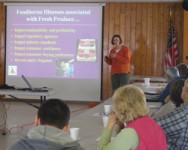
Produce Safety Alliance Grower Training Course

Who Should Attend
Fruit and vegetable growers and others interested in learning about produce safety, the Food Safety Modernization Act (FSMA) Produce Safety Rule, Good Agricultural Practices (GAPs), and co-management of natural resources and food safety. The PSA Grower Training Course is one way to satisfy the FSMA Produce Safety Rule requirement outlined in § 112.22(c) that requires ‘At least one supervisor or responsible party for your farm must have successfully completed food safety training at least equivalent to that received under standardized curriculum recognized as adequate by the Food and Drug Administration.'

What to Expect at the PSA Grower Training Course (Thursday, March 21)
The trainers will spend approximately seven hours of instruction time covering content contained in these seven modules:
  • Introduction to Produce Safety
  • Worker Health, Hygiene, and Training
  • Soil Amendments
  • Wildlife, Domesticated Animals, and Land Use
  • Agricultural Water (Part I: Production Water; Part II: Postharvest Water)
  • Postharvest Handling and Sanitation
  • How to Develop a Farm Food Safety Plan
In addition to learning about produce safety best practices, key parts of the FSMA Produce Safety Rule requirements are outlined within each module. There will be time for questions and discussion, so participants should come prepared to share their experiences and produce safety questions.

Benefits of Attending the Course
The course will provide a foundation of Good Agricultural Practices (GAPs) and co-management information, FSMA Produce Safety Rule requirements, and details on how to develop a farm food safety plan. Individuals who participate in this course are expected to gain a basic understanding of:
  • Microorganisms relevant to produce safety and where they may be found on the farm
  • How to identify microbial risks, practices that reduce risks, and how to begin implementing produce safety practices on the farm
  • Parts of a farm food safety plan and how to begin writing one
  • Requirements in the FSMA Produce Safety Rule and how to meet them. 
After attending the entire course, participants will be eligible to receive a certificate from the Association of Food and Drug Officials (AFDO) that verifies they have completed the training course. To receive an AFDO certificate, a participant must be present for the entire training and submit the appropriate paperwork to their trainer at the end of the course. 

Although we prefer you only bring 2 people from your farm or business, we understand in some cases it is necessary for a 3rd person to be included in the training.  For that reason, we have changed the pricing to accommodate this need. Registration is being accepted through the CCE Lake Ontario Fruit Program.

Out-of-State growers register at https://lof.cce.cornell.edu/event.php?id=1147

For more info, contact Craig Kahlke.


Registration Form (PDF; 186KB)

more crops
Apples

Apples

Apricots

Apricots

Asparagus

Asparagus

Beets

Beets

Blueberries

Blueberries

Broccoli

Broccoli

Brussels Sprouts

Brussels Sprouts

Cabbage

Cabbage

Carrots

Carrots

Cauliflower

Cauliflower

Cherries

Cherries

Cucumbers

Cucumbers

Dry Beans

Dry Beans

Eggplant

Eggplant

Ethnic Vegetables

Ethnic Vegetables

Garlic

Garlic

Grapes

Grapes

Horseradish

Horseradish

Kohlrabi

Kohlrabi

Leeks

Leeks

Lettuce / Leafy Greens

Lettuce / Leafy Greens

Melons

Melons

Nectarines

Nectarines

Onions

Onions

Parsnips

Parsnips

Peaches

Peaches

Pears

Pears

Peas

Peas

Peppers

Peppers

Plums

Plums

Potatoes

Potatoes

Pumpkins / Gourds

Pumpkins / Gourds

Radishes

Radishes

Raspberries / Blackberries

Raspberries / Blackberries

Rhubarb

Rhubarb

Rutabaga

Rutabaga

Snap Beans

Snap Beans

Squash - Summer

Squash - Summer

Squash- Winter

Squash- Winter

Strawberries

Strawberries

Sweet Corn

Sweet Corn

Sweet Potatoes

Sweet Potatoes

Tomatoes

Tomatoes

Turnips

Turnips

more crops

Upcoming Events

2026 Northeast Extension Fruit Consortium Winter Webinar Series

Event Offers DEC Credits

February 4, 2026 : Management of Up and Coming Strawberry Diseases in the Northeastern United States

Session 1: Management of Up and Coming Strawberry Diseases in the Northeastern United States


February 11, 2026 : Kiwiberry Production in the Northeast

Session 2: Kiwiberry Production in the Northeast


February 18, 2026 : Heat Mitigation- Sunburn and Fruit Coloring

Session 3: Heat Mitigation- Sunburn and Fruit Coloring


Event Offers DEC Credits

February 25, 2026 : The Dating Game- Updates in Lepidopteran Mating Disruption

Session 4: The Dating Game- Updates in Lepidopteran Mating Disruption


Event Offers DEC Credits

March 4, 2026 : USEPA Endangered Species Act Strategies and Pesticide Use

Session 5: USEPA Endangered Species Act Strategies and Pesticide Use


March 11, 2026 : Practical Drought Management for Fruit Growers

Session 6: Practical Drought Management for Fruit Growers

Managing the Invasive Swede Midge Webinar

Event Offers DEC Credits

March 6, 2026 : Managing the Invasive Swede Midge Webinar

Swede midge is an invasive fly that causes serious economic losses to brassica crops. Due to its small size and hidden feeding habits, swede midge is often called an "invisible pest" and damage may be misdiagnosed. In this webinar, we will review the swede midge life cycle and crop damage symptoms, current management recommendations, new research findings, and highlights from on-farm case studies with a focus on organic management. 

New Farm Manager Skills Day - Get the Tools You Need to Grow Your People (Hudson Valley)

March 10, 2026 : New Farm Manager Skills Day - Get the Tools You Need to Grow Your People
Millbrook, NY

Are you moving into a supervisory farm management role this season and want to get off to a good start?  Are you an experienced manager who wants to connect with other "people" managers and work on your skills?  This one-day workshop is for you! 

Announcements

Resources from CCE ENYCHP!


This website (https://enych.cce.cornell.edu/) contains our calendar of upcoming programs and registration links. For updated programmatic information, technical resources and links to newsletters please see our program blog site: https://blogs.cornell.edu/enychp/.
We also maintain the following online resources that you can view directly from these links:

• CCE ENYCH YouTube (program videos): https://www.youtube.com/channel/UCSk_E-ZKqSClcas49Cnvxkw

• CCE ENYCH Facebook (program social media): https://www.facebook.com/CCEENYCHP/

• CCE ENYCH Instagram (program social media): https://www.instagram.com/cceenychp/?hl=en