Eastern New York Commercial Horticulture Enrollment

Program Areas

  • Food Safety
  • Variety Evaluation
  • Market Development
  • Pest Management
  • Cultural Practices

Enrollment Benefits

  • Telephone / Email Consultations
  • Newsletter
  • Direct Mailings
  • Educational Meetings & Conferences
  • In-Field Educational Opportunities
  • On-Farm Research Trials

ENYCH Enrollment Form (PDF; 331KB)

Enrollee Login

Password:

Log In To Access:

  • Helpful Diagnostic Tool:
      What's wrong with my crop?

Not an Enrollee? Enroll Now!

Online Enrollment Form

Effects of Fruit Cooling on Spotted Wing Drosophila
August 22, 2012

Effects of Fruit Cooling on Spotted Wing Drosophila

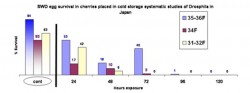
In some of the first literature written in Japan in 1939 (Kanzawa, T.) about spotted wing drosophila, Drosophila suzukii, (SWD), experiments were made regarding the sensitivity of the egg and larval stages of spotted wing drosophila to periods of temperatures above and below freezing (32o F).


As is noted in the two graphs below, at constant temperatures of up to 35o F, 96 hours or more of cooling resulted in total mortality of spotted wing drosophila eggs and larvae. This was also anecdotally confirmed in tests conducted in 2009 in California.

While temperatures below freezing are not useful to fruit shippers, temperatures in the area of 35o F are useful. However, it is important to note that for success the constancy of the temperature is critical. So, while in an ideal situation constant temperatures of 35o F or a little below are effective in SWD egg and larvae suppression when extended for periods longer than 96 hours, the reality can vary significantly from the ideal. Shipped fruit ordinarily do not experience lengthy regimes of constant temperature as they are moved from place to place. Temperatures of a refrigerator truck can vary by location inside and placement of the produce (ie on the side, towards the bottom etc.), and certainly the temperatures at the point of sale can vary from the ideal to room temperature to even warmer.

Additionally, while initial damage from SWD on raspberries, blackberries and strawberries can be difficult to detect, this is not the case for other fruits such as cherries or blueberries, where the activity of SWD will leave an unsightly blemish.

The take home message from this information is that while extended cooling can be suppressive of SWD, growers should not rely on cooling alone. It will still be important to manage SWD in field.
Thanks to Shinji Kawai for making the information from the 1939 Kanzawa paper available.

This article was posted on the UC Santa Cruz county blog by Mark Bold on March 23, 2010.  You can view more blog posts by going to: http://cesantacruz.ucdavis.edu/Strawberry_Nursery_Plant_Production/



more crops
Apples

Apples

Apricots

Apricots

Asparagus

Asparagus

Beets

Beets

Blueberries

Blueberries

Broccoli

Broccoli

Brussels Sprouts

Brussels Sprouts

Cabbage

Cabbage

Carrots

Carrots

Cauliflower

Cauliflower

Cherries

Cherries

Cucumbers

Cucumbers

Dry Beans

Dry Beans

Eggplant

Eggplant

Ethnic Vegetables

Ethnic Vegetables

Garlic

Garlic

Grapes

Grapes

Horseradish

Horseradish

Kohlrabi

Kohlrabi

Leeks

Leeks

Lettuce / Leafy Greens

Lettuce / Leafy Greens

Melons

Melons

Nectarines

Nectarines

Onions

Onions

Parsnips

Parsnips

Peaches

Peaches

Pears

Pears

Peas

Peas

Peppers

Peppers

Plums

Plums

Potatoes

Potatoes

Pumpkins / Gourds

Pumpkins / Gourds

Radishes

Radishes

Raspberries / Blackberries

Raspberries / Blackberries

Rhubarb

Rhubarb

Rutabaga

Rutabaga

Snap Beans

Snap Beans

Squash - Summer

Squash - Summer

Squash- Winter

Squash- Winter

Strawberries

Strawberries

Sweet Corn

Sweet Corn

Sweet Potatoes

Sweet Potatoes

Tomatoes

Tomatoes

Turnips

Turnips

more crops

Upcoming Events

Leading the Farm Team: Supervisory Skills for New Managers

April 14, 2026 : Session 1: Becoming a Supervisor

The transition from working alongside employees to supervising them can be challenging. This session explores the shift from individual contributor to supervisor and the mindset and skills needed to lead a team effectively. Participants will learn about the role of a supervisor, key leadership behaviors, and how to build trust and credibility with employees.


April 21, 2026 : Session 2: Improving Performance

This session will introduce the performance triad—clear expectations, training, and feedback—to support employee success. We will discuss practical communication strategies, how to give constructive feedback, and how supervisors can help employees improve their performance over time.


April 28, 2026 : Session 3: Managing Conflict

Supervisors are responsible for maintaining a professional and respectful workplace. This session covers some of the legal and ethical responsibilities of supervisors and the responsibilities managers have in addressing workplace concerns. 

Participants will also explore common sources of workplace conflict, learn to recognize potential biases that can influence management decisions, and discuss practical approaches for addressing difficult situations and resolving conflicts at work.

View Leading the Farm Team: Supervisory Skills for New Managers Details

Announcements

Resources from CCE ENYCHP!


This website (https://enych.cce.cornell.edu/) contains our calendar of upcoming programs and registration links. For updated programmatic information, technical resources and links to newsletters please see our program blog site: https://blogs.cornell.edu/enychp/.
We also maintain the following online resources that you can view directly from these links:

• CCE ENYCH YouTube (program videos): https://www.youtube.com/channel/UCSk_E-ZKqSClcas49Cnvxkw

• CCE ENYCH Facebook (program social media): https://www.facebook.com/CCEENYCHP/

• CCE ENYCH Instagram (program social media): https://www.instagram.com/cceenychp/?hl=en


NEWSLETTERS  |   CURRENT PROJECTS  |   IMPACT IN NY  |   SPONSORSHIP  |   RESOURCES  |   SITE MAP