Optimizing Nitrogen Fertility for Overwintered High Tunnel Spinach
Elisabeth Hodgdon, Vegetable Specialist
Eastern New York Commercial Horticulture
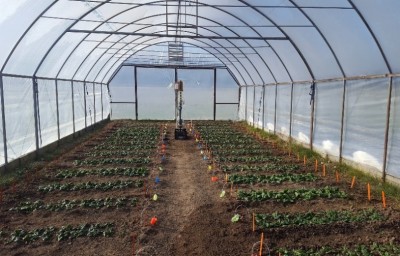
High tunnel (HT) environments allow for extended greens production during the shoulders of the season in the Northeast. In Northern NY, spinach can be planted in September for harvest in November and December, and will resume growth in February and March for late winter and early spring harvests. While fertility recommendations are fairly well established for field crops, soil nutrient dynamics in HTs are not as well understood. Nitrogen fertilizer application practices for overwintered HT spinach vary widely amongst farms. Although the recommended N fertility rate for field spinach is 100-125 lbs N/acre, anecdotally, we have heard reports of growers applying 200-600 lbs N/acre for overwintered high tunnel spinach. However, our team's previous research has shown little yield benefit of N fertilizer for HT spinach.
The objective of our experiment was to develop recommendations for optimal N fertility rates for overwintered HT spinach in Northern NY. If spinach yields are similar across N fertility treatments, growers may reduce costs of inputs in the fall by reducing fertilizer application.
Optimizing Nitrogen Fertility for Overwintered High Tunnel Spinach (pdf; 710KB)

Upcoming Events
Eastern New York Grapevine Pruning Workshops - Highland
March 19, 2026 : Eastern New York Grapevine Pruning Workshop
Higland, NY
This workshop is ideal for anyone looking to learn or refresh their grapevine pruning skills.
2026 Cornell Winter Fruit Webinar Series
January 22, 2026 : Blueberry Pruning and Soil Health to Minimize Pests and Maximize Yield
Week 1: Blueberry Pruning and Soil Health to Minimize Pests and Maximize Yield
January 29, 2026 : Cost of Production for Fruit Crops
Week 2: Cost of Production for Fruit Crops - A new tool for tree fruit, updates on berry production in NY, and strategies for tracking and using expense data
February 12, 2026 : Fire Blight Management Updates
Week 3: Fire Blight Management Updates - Pathogen Biology, Defense Inducers, Biopesticides, and Pruning Therapies
February 19, 2026 : Pink and Petal Fall Insecticides- Can We Strike the Right Balance?
Week 4: Pink and Petal Fall Insecticides - Can We Strike the Right Balance?
March 12, 2026 : Inoculating Orchards with Mycorrhizal Fungi
Week 5: Inoculating Orchards with Mycorrhizal Fungi
March 19, 2026 : St. Peachtrick's Day - Cherry Pruning Strategies and Plum Varieties for the Northeast
Week 6: St. Peachtrick's Day - Cherry Pruning Strategies and Plum Varieties for the Northeast
Leading the Farm Team: Supervisory Skills for New Managers
April 14, 2026 : Session 1: Becoming a Supervisor
The transition from working alongside employees to supervising them can be challenging. This session explores the shift from individual contributor to supervisor and the mindset and skills needed to lead a team effectively. Participants will learn about the role of a supervisor, key leadership behaviors, and how to build trust and credibility with employees.
April 21, 2026 : Session 2: Improving Performance
This session will introduce the performance triad—clear expectations, training, and feedback—to support employee success. We will discuss practical communication strategies, how to give constructive feedback, and how supervisors can help employees improve their performance over time.
April 28, 2026 : Session 3: Managing Conflict
Supervisors are responsible for maintaining a professional and respectful workplace. This session covers some of the legal and ethical responsibilities of supervisors and the responsibilities managers have in addressing workplace concerns.
Participants will also explore common sources of workplace conflict, learn to recognize potential biases that can influence management decisions, and discuss practical approaches for addressing difficult situations and resolving conflicts at work.