

Herbicide Options for Pumpkins and Squash
Chuck Bornt, Team Leader, Extension Vegetable Specialist
Eastern New York Commercial Horticulture
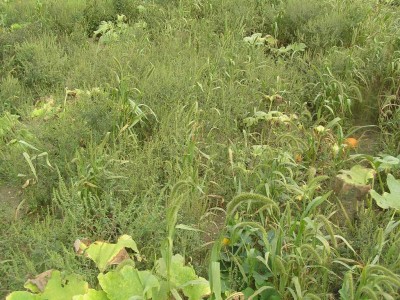
I know some early pumpkins and winter squash has already gone in the ground, but I suspect that the majority of them will be planted in the next couple weeks. The herbicides labeled and mentioned below all work best as post plant, pre-emergent applications. They are mostly seed germination inhibitors or root inhibitors. In my opinion, there are three important factors for these herbicides to work their best:
Field preparation: Fit and plant the field as closely together as possible. Do not fit the field and let it sit for more than 2 or 3 days before planting it as this will allow weed seeds to germinate (if the conditions are right). Most of these products' activity and efficacy is reduced when seeds are already germinated. If you have to wait, consider re-fitting the field with a shallow cultivation before planting. Also, make sure the field is not full of clumps as this will also reduce the efficacy of the herbicides.
Application timing: As with field fitting, do not delay your herbicide application for more than a day after planting! The same reason applies—this gives seeds time to germinate and reduces their activity. Planting and spraying your herbicide within a day will improve weed control.
Moisture: All of these materials require either a rain or irrigation after application in order to "activate" them. Not only does this activate the herbicide, but it also activates seed germination. If it looks like there is no rain coming for a while and you don't have irrigation, my suggestion is to go ahead and still get the herbicide on. It's better than waiting for a rain.
As I've said in years past, I would not use any of these products pre-emergent/post-plant by themselves with the exception of Strategy (already has 2 different active ingredients pre-mixed). We have seen that tank mixes are the best value and result in much better weed control. Many of these products have a narrow range of weeds they target so tank mixing a couple of them improves overall weed control. Tank mixes that we think have potential for pumpkins and winter squash are: Sandea (Profine is the generic version) plus Dual Magnum plus Command 3ME; Sandea plus Command 3ME or Strategy plus Sandea. As always, please read the label carefully and if you have questions about what you read below, please do not hesitate to call me at 518-859-6213 and I will do my best to answer them.
Dual II Magnum and Dual Magnum Notes: We go over this every year as I want to make sure everyone is in compliance! Yes, pumpkins are on both the Dual Magnum and Dual Magnum II label—however, if you read the label it clearly states that it can only be applied "as an inter-row or inter-hill application in pumpkin. Leave 1 foot of untreated area over the row, or 6 inches to each side of the planted hill and/or any emerged pumpkin foliage (inter-row or inter-hill means not directly over the planted seed or young pumpkin plants). "
What's it all mean? It means you cannot broadcast apply either Dual Magnum product according to the regular label that comes on the jug. In order to use the broadcast application, you must have the 24C Special Local Needs (SLN) label and the only formulation that has the broadcast application is Dual Magnum! Therefore, you cannot use Dual II Magnum broadcast on either pumpkins or winter squash! The broadcast method of Dual Magnum is an indemnified label which means that you accept the risk of using this material and any injury or crop loss is not the responsibility of the company. In order to obtain the correct label, you will need to register with Syngenta and indicate that you are using this product on those specific crops. The use of generic "Dual" products is not legal to use on pumpkins or winter squash.
How do I get the "indemnified label"? The process is simple, but needs to be done via the internet and needs to be completed every year too! Registering with Syngenta and obtaining the 24 c SLN:
1. Go to www.farmassist.com and in the top header bar click "Crop Protection" and then select "Indemnified Labels".
2. Either login or create a user name and password. Once you've logged in, the top of the header should say "Indemnified Label Search". Select New York and Dual Magnum.
3. Go to the second Dual Magnum 24 label that comes up and select the crop (it only allows you to choose one at a time so you will need to do this for as many crops as you want to apply Dual Magnum to).
4. You will then be navigated to a "WAIVER OF LIABILITY AND INDEMNIFICATION AGREEMENT" page where you will either accept or decline the special instructions for using this product on the selected crops.
5. Once you've accepted the liability, the label will appear and you should print it as well as save it on your computer. If you decline it, the labels will not appear and you legally cannot apply Dual Magnum to the selected crop(s).
6. Farmassist will save all of the indemnified labels you have agreed to in case you lose your label and need another one. If you need assistance you can call the Syngenta Customer Resource Center at 866-796-4368.
Remember, you need to have a copy of the Dual Magnum 24C label in your possession when using this material. More information regarding other labeled materials can be found in Table 1.
Table 1: Recommended Pre-Emergent/Post Seeding Herbicides for Pumpkins and Winter Squash
Product
Crops
Weeds controlled
Rate
Comments
Sandea, Profine 75 (halosulfuron)
All cucurbits
Broadleaves (pigweed, velvetleaf, etc.)
0.5 - 1.0 ounces per acre
Needs to be mixed with a grass herbicide when used pre-emergent. Can stunt and delay emergence especially at higher rates but temporary (I recommend 0.5 oz rate), short residual of about 4 weeks, will start to see some weed species breaking through (common lambsquarter, Eastern black nightshade) around the 4th of July. Using a 0.5 oz. once pre-emergent allows you to use another 0.5oz. once post emergent.
Dual Magnum
(S-metolachlor)
Pumpkins, winter squash
Mostly grasses and some broadleaf suppression
2/3—1.33 pints per acre depending on soil type
PLEASE SEE OTHER NOTES ON DUAL MAGNUM! I have seen very good results and limited injury using the 1.0 pints per acre rate. Do not incorporate as this increases the risk of severe injury! Best if used as a post plant pre-emergent and can be used post-transplant within 72 hours of planting (weed seed germination issues).
Command 3ME
(clomazone)
All cucurbits
Annual grasses and some broadleaves
2/3 - 1.33 pints per acre depending on soil type
Labeled on all cucurbits (Label actually says "Do not use on Jack-O-Lantern pumpkins" because the companies distributing this product will not accept liability for potential off-color responses that have been observed in numerous varieties). I find that the 1.0 pint per acre rate is used and provides good control. Do not incorporate! The ME (micro-encapsulated) formulation does not need to be incorporated! May be used prior to seeding or transplanting (make sure transplant is planted below the chemical barrier) or post seeding but before crop emerges.
Curbit EC
(ethalfluralin)
All cucurbits
Mostly annual grasses and some broadleaf suppression
3.0—4.5 pints per acre depending on soil & organic matter level
Use as a post plant pre-emergent application only within 2 days of planting or banded application between rows after crop emergence or transplanting (be very careful of drifting onto the crop). Do not use under plastic mulches or rowcovers. Cold, wet soils can increase injury or even result in crop failure! Label recommends using a minimum of 20 gals/acre fixed spray volume.
Weed control may be reduced on soils with organic matter over 5%. Not recommended for soils with more than 10% organic matter.
Strategy (Pre-mix of Command and Curbit)
(clomazone + ethalfluralin)
All cucurbits
Most annual grasses and some broadleaves
2.0 - 6.0 pints depending on soil texture
I would recommend no less than 4 pints/acre. Do not incorporate, recommended as a post plant pre-emergent or banded application between rows after emergence or transplanting. Do not broadcast apply and then transplant into treated soil as severe injury will occur. It can also be banded to row middles after a cultivation. Do not let this material freeze in storage as it could potentially settle out and clog your sprayer screens, tips etc. Label also recommends to use 10 to 30 gallons per acre finished spray volume. Be sure to check the label as there are crop rotational restrictions that are rate dependent.
Reflex
(fomesafen)
Pumpkins and winter squash except butternut
Broadleaves and some annual grass suppression
0.5—1.0 pints per acre
24C Special Local Needs label on pumpkins, summer squash and most varieties of winter squash, except butternut. "Indemnified" label like Dual Magnum which means you accept any crop losses associated with using this material and same registration process as Dual Magnum. See the "Registering with Syngenta and obtaining the 24 c SLN" section under Dual Magnum. For direct seeded crops you need to apply to the row middles only or leave the area over the seed furrow untreated. Do not use as a broadcast application on direct seeded pumpkins or squash! However, for transplants you can use it as a pre-transplant non-incorporated pre-emergence (weed seeds) broadcast application up to 7 days prior to transplanting. Do not exceed 1 pint per acre of Reflex on pumpkins, winter or summer squash per season. Please note the 18-month crop rotation restrictions for sweet corn. Do not use Reflex alone.
This article is from the May 17 2018 edition of the ENYCHP Vegetable News. Click Here to view the full newsletter.


Apples

Apricots

Asparagus

Beets

Blueberries

Broccoli

Brussels Sprouts

Cabbage

Carrots

Cauliflower

Cherries

Cucumbers

Dry Beans

Eggplant

Ethnic Vegetables

Garlic

Grapes

Horseradish

Kohlrabi

Leeks

Lettuce / Leafy Greens

Melons

Nectarines

Onions

Parsnips

Peaches

Pears

Peas

Peppers

Plums

Potatoes

Pumpkins / Gourds

Radishes

Raspberries / Blackberries

Rhubarb

Rutabaga

Snap Beans

Squash - Summer

Squash- Winter

Strawberries

Sweet Corn

Sweet Potatoes

Tomatoes

Turnips

Upcoming Events
Introduction to Small Fruit Workshop

September 21, 2026
Millbrook, NY
Join Cornell Cooperative Extension of Dutchess County for a presentation on small fruit establishment, production, and management with ENYCHP's Berry Specialist Heather Kase!