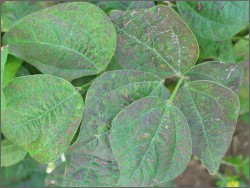
O-zone Injury on Vegetables
Crystal Stewart-Courtens, Extension Vegetable Specialist
Eastern New York Commercial Horticulture

Common ozone symptoms are small, irregular, shaped spots that range in color from dark brown to black (stipple like) or light tan to white (fleck like). These spots are found only on the upper surface of the leaf. Very young and old leaves are less susceptible to ozone while newly mature leaves are the most susceptible. With severe damage, symptoms may extend to the lower leaf surface.
Insect feeding (red spider mite and some leafhoppers) produce flecks on the upper surface of leaves, much like ozone injury. Flecks from insect feeding are usually spread uniformly over the leaf surface while ozone flecks are concentrated in specific areas, usually most pronounced at the leaf tip and along the margins.
The most sensitive crops include: Bean, Broccoli, Muskmelon, Onion, Potato, Radish, Spinach, Sweet Corn, Tomato
Intermediate crops include: Carrot, Endive, Parsley, Parsnip, Turnip
Tolerant crops include: Beet, Cucumber, Lettuce

Upcoming Events
How to Diversify or Scale Up with Confidence for Profitability - Inspired by Annie's Project
February 4, 2026
February 11, 2026
February 25, 2026
Do you have an idea for a new enterprise to add value to your farm? Maybe you're considering scaling up for a potential market opportunity but just aren't sure if it's a good fit for your business. Join Cornell Cooperative Extensions of Allegany County, Broome County, Madison County, Onondaga County, Niagara County, Tioga County, the Niagara Small Business Development Center, and the Eastern NY Commercial Horticulture Team for a hybrid series on Wednesdays in February, starting on February 4th that will answer these questions and more. Annie's Project seeks to empower farm women through education, networks and resources. We welcome, and encourage, learning and sharing amongst farm women as we help you grow as decision-makers and leaders on your farm.
2026 Northeast Extension Fruit Consortium Winter Webinar Series
February 4, 2026 : Management of Up and Coming Strawberry Diseases in the Northeastern United States
Session 1: Management of Up and Coming Strawberry Diseases in the Northeastern United States
February 11, 2026 : Kiwiberry Production in the Northeast
Session 2: Kiwiberry Production in the Northeast
February 18, 2026 : Heat Mitigation- Sunburn and Fruit Coloring
Session 3: Heat Mitigation- Sunburn and Fruit Coloring
February 25, 2026 : The Dating Game- Updates in Lepidopteran Mating Disruption
Session 4: The Dating Game- Updates in Lepidopteran Mating Disruption
March 4, 2026 : USEPA Endangered Species Act Strategies and Pesticide Use
Session 5: USEPA Endangered Species Act Strategies and Pesticide Use
March 11, 2026 : Practical Drought Management for Fruit Growers
Session 6: Practical Drought Management for Fruit Growers
2026 Cornell Winter Fruit Webinar Series
January 22, 2026 : Blueberry Pruning and Soil Health to Minimize Pests and Maximize Yield
Week 1: Blueberry Pruning and Soil Health to Minimize Pests and Maximize Yield
January 29, 2026 : Cost of Production for Fruit Crops
Week 2: Cost of Production for Fruit Crops - A new tool for tree fruit, updates on berry production in NY, and strategies for tracking and using expense data
February 12, 2026 : Fire Blight Management Updates
Week 3: Fire Blight Management Updates - Pathogen Biology, Defense Inducers, Biopesticides, and Pruning Therapies
February 19, 2026 : Pink and Petal Fall Insecticides- Can We Strike the Right Balance?
Week 4: Pink and Petal Fall Insecticides - Can We Strike the Right Balance?
March 12, 2026 : Inoculating Orchards with Mycorrhizal Fungi
Week 5: Inoculating Orchards with Mycorrhizal Fungi
March 19, 2026 : St. Peachtrick's Day - Cherry Pruning Strategies and Plum Varieties for the Northeast
Week 6: St. Peachtrick's Day - Cherry Pruning Strategies and Plum Varieties for the Northeast