

Be on the Lookout for Southern Blight
Ethan Grundberg, Vegetable Specialist
Eastern New York Commercial Horticulture
Southern Blight is caused by the fungal pathogen Sclerotium rolfsii and has historically only been a concern to growers in southern states. However, Cornell pathologist Dr. Sarah Pethybridge has seen an
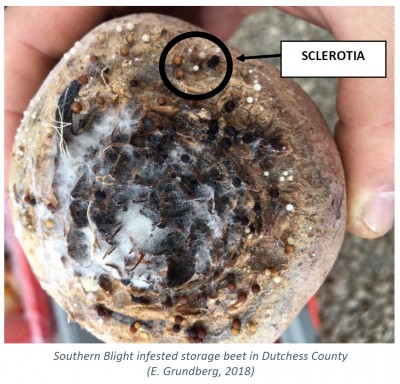
increase in the incidence of Southern Blight in New York over the past several years. This winter, Dr. Pethybridge confirmed the presence of S. rolfsii on golden storage beets in Dutchess County. Given the broad host range of the pathogen that includes over 1,200 crops and weeds, it is imperative that growers who suspect a possible Southern Blight infestation on their farm contact extension to confirm the diagnosis to assist with optimizing crop rotations to reduce soilborne inoculum.
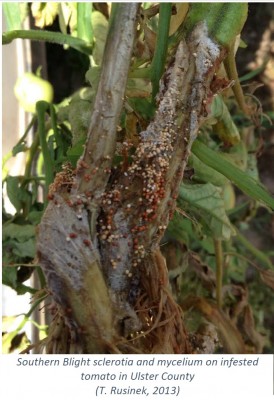
The most common symptom observed in the field is wilting or collapse of the plant. Upon closer inspection, affected plants often have reddish-brown dry lesions at the soil line. Fungal mycelium is also usually present as a thick white mat around the base of the stem. The Southern Blight pathogen also produces overwintering bodies called sclerotia under the right environmental conditions (typically high humidity with temperatures about 80 °F, but sclerotia were found on beets in cold storage at 40 °F). The sclerotia formed by S. rolfsii are a key identifying feature; they are small balls similar in appearance to Dijon mustard seeds that change in color from white to golden to reddish-brown (see image). These sclerotia can survive in the soil for years and endure temperature extremes and drought while waiting to germinate in the presence of a host plant under the right environmental conditions.
Crops that are most commonly affected by Southern Blight are tomatoes, peppers, snap beans, onions, garlic, and Jerusalem artichokes; however, as indicated above, the pathogen can grow and reproduce on a much broader range of plants. Like with most diseases, early detection and proper identification are critical! Infested plants should be removed and destroyed if possible. Symptomatic plants should NOT be placed in compost, as they may contain sclerotia that will then be spread with the compost to other fields. Some small grains and corn are less susceptible to Southern Blight and can be used in rotation in heavily infested fields, but crop rotation is typically not a viable strategy for management of this pathogen given its broad host range. Initial research in New York suggests that deep plowing of infested fields to bury sclerotia and infested residue at least 6-inches deep can lower the pathogen's survival rate.
Several effective chemical controls are available to conventional growers, but they must be applied preventatively. Labeled formulations of azoxystrobin (Quadris), pyraclostrobin (Cabrio), and penthiopyrad (Fontelis) have been effective for growers in the south. Some research has suggested that OMRI-approved biocontrol agents, such as Trichoderma harzianum (RootShield, TerraGrow) and Gliocladium virens (SoilGard), may also help reduce the number of Southern Blight sclerotia and prevent colonization of host plant tissue by the pathogen.


Apples

Apricots

Asparagus

Beets

Blueberries

Broccoli

Brussels Sprouts

Cabbage

Carrots

Cauliflower

Cherries

Cucumbers

Dry Beans

Eggplant

Ethnic Vegetables

Garlic

Grapes

Horseradish

Kohlrabi

Leeks

Lettuce / Leafy Greens

Melons

Nectarines

Onions

Parsnips

Peaches

Pears

Peas

Peppers

Plums

Potatoes

Pumpkins / Gourds

Radishes

Raspberries / Blackberries

Rhubarb

Rutabaga

Snap Beans

Squash - Summer

Squash- Winter

Strawberries

Sweet Corn

Sweet Potatoes

Tomatoes

Turnips

Upcoming Events
Champlain Valley Orchard Storage Meeting
August 26, 2026
Chazy, NY
Join various experts from Cornell and Cooperative Extension at an orchard storage meeting for the Champlain Valley in Chazy from 1 to 4PM on August 26th. Free to attend, however we do ask that you register ahead so we know how many people to expect.