Eastern New York Commercial Horticulture Enrollment

Program Areas

  • Food Safety
  • Variety Evaluation
  • Market Development
  • Pest Management
  • Cultural Practices

Enrollment Benefits

  • Telephone / Email Consultations
  • Newsletter
  • Direct Mailings
  • Educational Meetings & Conferences
  • In-Field Educational Opportunities
  • On-Farm Research Trials

ENYCH Enrollment Form (PDF; 372KB)

Enrollee Login

Password:

Log In To Access:

  • Helpful Diagnostic Tool:
      What's wrong with my crop?

Not an Enrollee? Enroll Now!

Online Enrollment Form

High Tunnel Tomatoes - Early Pruning Pays off

Amy Ivy, Vegetable Specialist
Eastern New York Commercial Horticulture
May 2, 2018

greenhouse

May is an insane time around any NY vegetable farm and it's a challenge to prioritize the mountain of tasks each day. But a little time spent pruning and training your high tunnel tomato plants now can really pay off later. Not only will they yield better, your labor will be more efficient during harvest since workers won't be plowing through a dense tangle of leafy stems to get to the tomatoes.

Here's a quick review:

Remove lower leaves up to the first fruit cluster. Bend the leaf up, then down and it should snap off cleanly, making quick work of this simple but important task. Why? It increases airflow around the plant to discourage disease and makes the plant easier to work around.

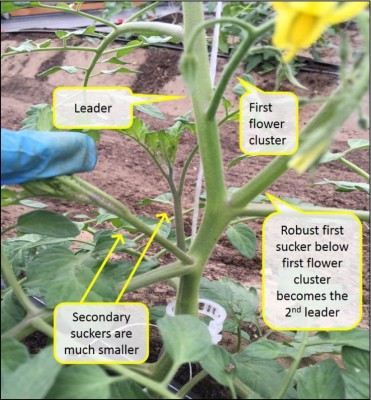
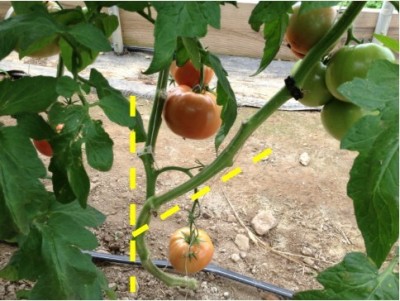
Strong Y - whether you are training determinate or double leader indeterminate (see below) start both with the Strong Y. See the photo to locate the weaker suckers to remove and the co-dominate sucker to keep just below the first flower cluster. Allow only the main leader and co-dominate leader to develop, removing all the other suckers and leaves up to this ‘Y' junction on the plant. Why? The lower suckers are less productive. Removing them sends the plant's food energy to the remaining stems, shoots and fruit.

Determinate tomatoes - train them to the ‘stake and weave' aka ‘Florida weave' system. Set a post between every 2-3 plants and start the horizontal twining early so the plants can grow up through the support. Why? This level of support will keep the aisles open for efficient worker movement and will keep the fruit up off the ground for easy harvest.

Indeterminate tomatoes - For large slicing tomatoes some growers prefer single leaders, some prefer double. When in doubt, the double leader system works well in most situations.

In our cherry tomato trial we found the double leader system was the best option in terms of labor efficiency and yield, compared to a single or multi leader system.


Check out these helpful factsheets for more photos and details:


tomato2


 This article is from the May 3, 2018 edition of ENYCHP Vegetable News.  To read the full newsletter,CLICK HERE.



more crops
Apples

Apples

Apricots

Apricots

Asparagus

Asparagus

Beets

Beets

Blueberries

Blueberries

Broccoli

Broccoli

Brussels Sprouts

Brussels Sprouts

Cabbage

Cabbage

Carrots

Carrots

Cauliflower

Cauliflower

Cherries

Cherries

Cucumbers

Cucumbers

Dry Beans

Dry Beans

Eggplant

Eggplant

Ethnic Vegetables

Ethnic Vegetables

Garlic

Garlic

Grapes

Grapes

Horseradish

Horseradish

Kohlrabi

Kohlrabi

Leeks

Leeks

Lettuce / Leafy Greens

Lettuce / Leafy Greens

Melons

Melons

Nectarines

Nectarines

Onions

Onions

Parsnips

Parsnips

Peaches

Peaches

Pears

Pears

Peas

Peas

Peppers

Peppers

Plums

Plums

Potatoes

Potatoes

Pumpkins / Gourds

Pumpkins / Gourds

Radishes

Radishes

Raspberries / Blackberries

Raspberries / Blackberries

Rhubarb

Rhubarb

Rutabaga

Rutabaga

Snap Beans

Snap Beans

Squash - Summer

Squash - Summer

Squash- Winter

Squash- Winter

Strawberries

Strawberries

Sweet Corn

Sweet Corn

Sweet Potatoes

Sweet Potatoes

Tomatoes

Tomatoes

Turnips

Turnips

more crops

Upcoming Events

Expanding Farm Sales: Markets, Profits, and Branding Series

January 10, 2026

Looking to diversify where you sell your farm products? This four-part workshop series helps farmers explore new opportunities in direct-to-consumer, wholesale, and institutional markets. Learn how to meet buyer expectations, price for profitability, and build lasting relationships that support your business goals. Participants will strengthen marketing and communication skills, evaluate which sales channels best fit their farm, and connect with buyers, distributors, and local partners who can help expand their reach. Whether you're just starting out or ready to grow your market presence, this program will help you chart the right path for your farm's future.

Four Session Series: Saturdays from 10AM to Noon, January 10-January 31, 2026

Attend at one of three locations: Schoharie Extension Center - Cobleskill, NY; Otsego Education Center - Cooperstown, NY; Via Zoom

Pre-registration is requested! Fee: $25 Register Here

Any questions can be directed to Kelley Doolin at kmd322@cornell.edu

View Expanding Farm Sales: Markets, Profits, and Branding Series Details

Pesticide Applicator Certification Exam Prep Course

January 13 - January 14, 2026

Join ENYCHP specialists for an in-depth review of topics covered on the NYS DEC pesticide applicator certification exam. This two-day virtual course includes explanation of key concepts on the core exam, test-taking tips for the core and category exam, practice questions, and Q&A with instructors. Course materials, including program recordings, practice exams, and DEC materials will be available to registrants after the program. This training is geared toward certification categories 1A (agricultural plant), 21 (field and forage), 22 (fruit), and 23 (vegetable). 

View Pesticide Applicator Certification Exam Prep Course Details

I thought I was covered for that! Farm Insurance Webinar Series, Jan-Feb 2026

January 13, 2026 : Session 1: Insurance and Risk Management 101

Insurance and Risk Management 101. This first webinar will cover many of the general provisions found in insurance policies and describe some of the terms to be aware of when you are considering your options. Steve Hadcock, Capital District Hort Team and Greg Murk, FarmNet. 


January 20, 2026 : Session 2: Liability Insurance

Coverage for the risk that your business will cause harm to someone.  Are you having people on your farm or selling a food product?  You might need liability insurance. Robert Hadad, Cornell Vegetable Program, Elizabeth Higgins, Eastern NY Commercial Hort Program.


January 27, 2026 : Session 3:Protecting Yourself from Disasters (Crop Insurance, USDA FSA programs and Flood Insurance)

Are you protected from a weather event on your farm? Learn about your options for Disaster Coverage (crop insurance, FSA programs, flood insurance). Elizabeth Higgins, Eastern NY Commercial Hort Program.


February 3, 2026 : Session 4: Insuring People (health, life and disability insurance)

Options for health insurance, life insurance and disability insurance, and how they can help farmers and their employees. Maire Ullrich, CCE Orange County and Lucas Smith, Cornell Ag Workforce Development 


February 10, 2026 : Session 5: Property Insurance

Insuring your infrastructure, equipment, and livestock from loss. Learn about the types of coverage, and the risks they reduce. Colin Hostetter, Tri-County Ag Team, Desiree Keever, CCE Delaware County and Steve Glick, Kevin Daniels Agency.

View I thought I was covered for that! Farm Insurance Webinar Series, Jan-Feb 2026 Details

Announcements

Resources from CCE ENYCHP!


This website (https://enych.cce.cornell.edu/) contains our calendar of upcoming programs and registration links. For updated programmatic information, technical resources and links to newsletters please see our program blog site: https://blogs.cornell.edu/enychp/.
We also maintain the following online resources that you can view directly from these links:

• CCE ENYCH YouTube (program videos): https://www.youtube.com/channel/UCSk_E-ZKqSClcas49Cnvxkw

• CCE ENYCH Facebook (program social media): https://www.facebook.com/CCEENYCHP/

• CCE ENYCH Instagram (program social media): https://www.instagram.com/cceenychp/?hl=en


NEWSLETTERS  |   CURRENT PROJECTS  |   IMPACT IN NY  |   SPONSORSHIP  |   RESOURCES  |   SITE MAP