Eastern New York Commercial Horticulture Enrollment

Program Areas

  • Food Safety
  • Variety Evaluation
  • Market Development
  • Pest Management
  • Cultural Practices

Enrollment Benefits

  • Telephone / Email Consultations
  • Newsletter
  • Direct Mailings
  • Educational Meetings & Conferences
  • In-Field Educational Opportunities
  • On-Farm Research Trials

ENYCH Enrollment Form (PDF; 331KB)

Enrollee Login

Password:

Log In To Access:

  • Helpful Diagnostic Tool:
      What's wrong with my crop?

Not an Enrollee? Enroll Now!

Online Enrollment Form

Start managing for bacterial diseases in field tomatoes at transplanting

Crystal Stewart-Courtens, Extension Vegetable Specialist
Eastern New York Commercial Horticulture

May 9, 2018

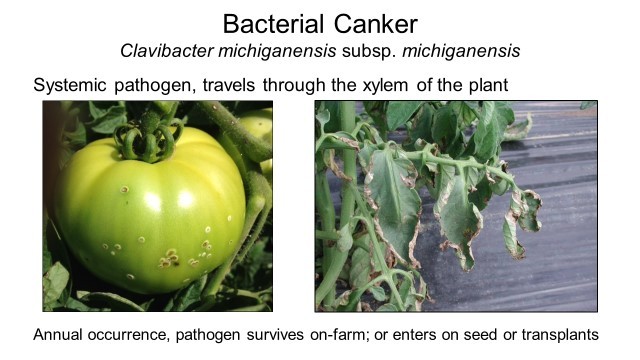
Bacterial speck, spot, and canker continue to be perennial problems in Eastern NY. We are learning that effective management is a season-long effort, starting with proper greenhouse sanitation and continuing with regular plant protection. The good news is that there are more tools available for disease management than once thought; the bad news is management is more intensive than we'd like.
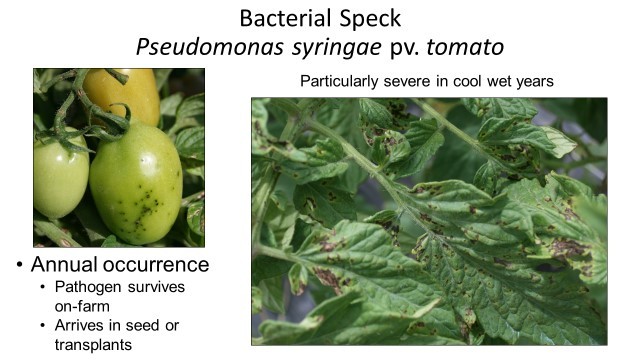
Image 1

Source: Dr. Christine Smart

Image 2

Source: Dr. Christine Smart


Start with clean stakes


This is a best practice because of other tomato diseases too, so hopefully you are already cleaning your tomato stakes. Every year wooden and metal stakes should be power-washed to remove excess soil, then sterilized using either bleach, Green-Shield,  Xero-Tol, or an equivalent product. It is important for the stakes to sit in a sterilizing solution long enough to penetrate the nooks and crannies of the wood and kill any lurking bacteria or fungal structures. Remember that bleach will damage metal stakes if not rinsed off.


Protect plants starting early

Bacterial diseases are most effectively controlled by preventing their infection. It's not always clear where inoculum comes from, but we know that growers who have struggled with bacterial diseases in the past are having some success with starting a protective spray program shortly after transplanting. The traditional spray for both organic and conventional growers has been copper; however, there is concern about applying the amount of copper per season that would be needed to provide continuous control. Dr. Christine Smart has been doing trialing of alternatives to copper for bacterial canker and bacterial speck, and has found that there are products equally effective to copper available on the market.

                   2017 Bacterial Speck Trial Results: Dr. Smart

    *Products with the same letter are not significantly different

Treatment and Rate/A

Active Ingredient

   Mean AUDPC

(disease over time)

Unsprayed control

234.8 a

Regalia EC 4 qt

Reynoutria sachalinensis extract

174.5  b

Double Nickel LC 32 fl oz

Bacillus amyloliquefaciens

166.3 b

Actinovate AG 12 oz

Streptomyces lydicus

 161.3 b

LifeGard WG 4.5oz/100 gal

Bacillus mycoides

153.8 b

Actinovate AG+Regalia EC

150.0 b

Champ 30 WG  2.0 lb

Copper hydroxide

145.0 b


              2017 Bacterial Canker Trial: Dr. Smart

                           # of fruit without lesions

*Products with different letters are significantly different
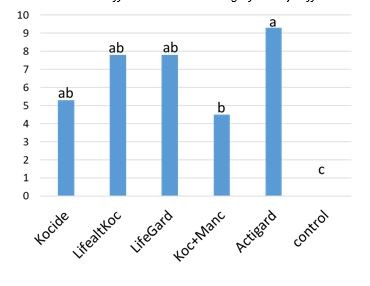
It's important to protect leaves because fruit quality will decrease as the plant weakens and is defoliated. However, fruit quality is downgraded by just one lesion. According to Dr. Smart, bacterial infection of fruit occurs before it reaches ping-pong size. Keeping fruit protected prior to this point will effectively result in lesion-free fruit. This knowledge may adjust timing of sprays.

Because copper and other products such as Actigard have, on average across bacterial diseases, equal efficacy, alternating between them could help with resistance management and will reduce copper loading the in soil. All of these products wash off in rains, so protecting weekly or between rain events is recommended for best results with field tomatoes.

One quick note—you will notice that none of the products listed are antibiotics. There are no antibiotics listed for vegetable production—products listed are either broad spectrum biocides, such as copper, stimulate plant immunity, such as Regalia and LifeGard, or competitively colonize the leaf and suppress other bacteria, such as the Bacillus products.



more crops
Apples

Apples

Apricots

Apricots

Asparagus

Asparagus

Beets

Beets

Blueberries

Blueberries

Broccoli

Broccoli

Brussels Sprouts

Brussels Sprouts

Cabbage

Cabbage

Carrots

Carrots

Cauliflower

Cauliflower

Cherries

Cherries

Cucumbers

Cucumbers

Dry Beans

Dry Beans

Eggplant

Eggplant

Ethnic Vegetables

Ethnic Vegetables

Garlic

Garlic

Grapes

Grapes

Horseradish

Horseradish

Kohlrabi

Kohlrabi

Leeks

Leeks

Lettuce / Leafy Greens

Lettuce / Leafy Greens

Melons

Melons

Nectarines

Nectarines

Onions

Onions

Parsnips

Parsnips

Peaches

Peaches

Pears

Pears

Peas

Peas

Peppers

Peppers

Plums

Plums

Potatoes

Potatoes

Pumpkins / Gourds

Pumpkins / Gourds

Radishes

Radishes

Raspberries / Blackberries

Raspberries / Blackberries

Rhubarb

Rhubarb

Rutabaga

Rutabaga

Snap Beans

Snap Beans

Squash - Summer

Squash - Summer

Squash- Winter

Squash- Winter

Strawberries

Strawberries

Sweet Corn

Sweet Corn

Sweet Potatoes

Sweet Potatoes

Tomatoes

Tomatoes

Turnips

Turnips

more crops

Upcoming Events

I thought I was covered for that! Farm Insurance Webinar Series, Jan-Feb 2026

January 13, 2026 : Session 1: Insurance and Risk Management 101

Insurance and Risk Management 101. This first webinar will cover many of the general provisions found in insurance policies and describe some of the terms to be aware of when you are considering your options. Steve Hadcock, Capital District Hort Team and Greg Murk, FarmNet. 


January 20, 2026 : Session 2: Liability Insurance

Coverage for the risk that your business will cause harm to someone.  Are you having people on your farm or selling a food product?  You might need liability insurance. Robert Hadad, Cornell Vegetable Program, Elizabeth Higgins, Eastern NY Commercial Hort Program.


January 27, 2026 : Session 3:Protecting Yourself from Disasters (Crop Insurance, USDA FSA programs and Flood Insurance)

Are you protected from a weather event on your farm? Learn about your options for Disaster Coverage (crop insurance, FSA programs, flood insurance). Elizabeth Higgins, Eastern NY Commercial Hort Program.


February 3, 2026 : Session 4: Insuring People (health, life and disability insurance)

Options for health insurance, life insurance and disability insurance, and how they can help farmers and their employees. Maire Ullrich, CCE Orange County and Lucas Smith, Cornell Ag Workforce Development 


February 10, 2026 : Session 5: Property Insurance

Insuring your infrastructure, equipment, and livestock from loss. Learn about the types of coverage, and the risks they reduce. Colin Hostetter, Tri-County Ag Team, Desiree Keever, CCE Delaware County and Steve Glick, Kevin Daniels Agency.

View I thought I was covered for that! Farm Insurance Webinar Series, Jan-Feb 2026 Details

How to Diversify or Scale Up with Confidence for Profitability - Inspired by Annie's Project

February 4, 2026
February 11, 2026
February 25, 2026

Do you have an idea for a new enterprise to add value to your farm? Maybe you're considering scaling up for a potential market opportunity but just aren't sure if it's a good fit for your business. Join Cornell Cooperative Extensions of Allegany County, Broome County, Madison County, Onondaga County, Niagara County, Tioga County, the Niagara Small Business Development Center, and the Eastern NY Commercial Horticulture Team for a hybrid series on Wednesdays in February, starting on February 4th that will answer these questions and more.   Annie's Project seeks to empower farm women through education, networks and resources. We welcome, and encourage, learning and sharing amongst farm women as we help you grow as decision-makers and leaders on your farm.

View How to Diversify or Scale Up with Confidence for Profitability - Inspired by Annie's Project Details

2026 Northeast Extension Fruit Consortium Winter Webinar Series

Event Offers DEC Credits

February 4, 2026 : Management of Up and Coming Strawberry Diseases in the Northeastern United States

Session 1: Management of Up and Coming Strawberry Diseases in the Northeastern United States


February 11, 2026 : Kiwiberry Production in the Northeast

Session 2: Kiwiberry Production in the Northeast


February 18, 2026 : Heat Mitigation- Sunburn and Fruit Coloring

Session 3: Heat Mitigation- Sunburn and Fruit Coloring


Event Offers DEC Credits

February 18, 2026 : The Dating Game- Updates in Lepidopteran Mating Disruption

Session 4: The Dating Game- Updates in Lepidopteran Mating Disruption


Event Offers DEC Credits

March 4, 2026 : USEPA Endangered Species Act Strategies and Pesticide Use

Session 5: USEPA Endangered Species Act Strategies and Pesticide Use


March 11, 2026 : Practical Drought Management for Fruit Growers

Session 6: Practical Drought Management for Fruit Growers

View 2026 Northeast Extension Fruit Consortium Winter Webinar Series Details

Announcements

Resources from CCE ENYCHP!


This website (https://enych.cce.cornell.edu/) contains our calendar of upcoming programs and registration links. For updated programmatic information, technical resources and links to newsletters please see our program blog site: https://blogs.cornell.edu/enychp/.
We also maintain the following online resources that you can view directly from these links:

• CCE ENYCH YouTube (program videos): https://www.youtube.com/channel/UCSk_E-ZKqSClcas49Cnvxkw

• CCE ENYCH Facebook (program social media): https://www.facebook.com/CCEENYCHP/

• CCE ENYCH Instagram (program social media): https://www.instagram.com/cceenychp/?hl=en


NEWSLETTERS  |   CURRENT PROJECTS  |   IMPACT IN NY  |   SPONSORSHIP  |   RESOURCES  |   SITE MAP