

Fire Blight Sampling
June 8, 2016
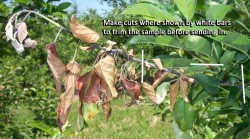
It is only possible to isolate the bacteria (Erwinia amylovora) from fresh, active lesions, where healthy tissue meets the diseased tissue - the lesion margin.
It is impossible to isolate fire blight bacteria from dead, dried out tissue.
The Lesion Margin
Collect samples that include about 3 inches of healthy tissue beyond the infected tissue, and include about 3 inches of infected tissue. Do not submit all the dead branch of the strike, this is often too long and can be cut back, as described, to 3 inches of infected tissue above 3 inches of healthy tissue.
If possible, refrigerate infected trees and strikes.
Protect samples from drying out prior to submitting them.
Do not collect entire branches or trees unless symptoms are unusual.
Please see the attached form for more information.
Fire Blight Sample Form (pdf; 226KB)


Apples

Apricots

Asparagus

Beets

Blueberries

Broccoli

Brussels Sprouts

Cabbage

Carrots

Cauliflower

Cherries

Cucumbers

Dry Beans

Eggplant

Ethnic Vegetables

Garlic

Grapes

Horseradish

Kohlrabi

Leeks

Lettuce / Leafy Greens

Melons

Nectarines

Onions

Parsnips

Peaches

Pears

Peas

Peppers

Plums

Potatoes

Pumpkins / Gourds

Radishes

Raspberries / Blackberries

Rhubarb

Rutabaga

Snap Beans

Squash - Summer

Squash- Winter

Strawberries

Sweet Corn

Sweet Potatoes

Tomatoes

Turnips

Upcoming Events
Introduction to Small Fruit Workshop

September 21, 2026
Millbrook, NY
Join Cornell Cooperative Extension of Dutchess County for a presentation on small fruit establishment, production, and management with ENYCHP's Berry Specialist Heather Kase!