

Insecticides Labeled for Colorado Potato Beetle
Chuck Bornt, Team Leader, Extension Vegetable Specialist
Eastern New York Commercial Horticulture
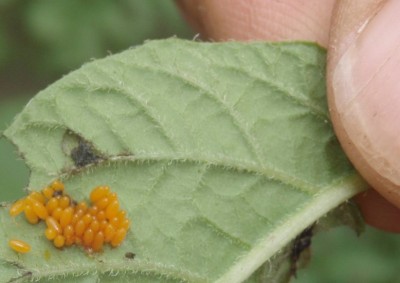
Insecticides Labeled for Colorado Potato Beetle Control. (This is not a complete list)
Product name
IRAC Group
Rate per Acre
Comments
Coragen
28
3.5-5.0 fl. oz
Do not apply within 100 feet of a water body, allow a minimum interval of 5 days between applications
Voliam Xpress
28
6.0-9.0 fl oz
Do not apply within 100 feet of a water body, allow a minimum interval of 5 days between applications, do not exceed 27 fl oz/acre per season
Agri-Mek SC
6
1.75-3.5 fl oz
Must be mixed with a non-ionic activator type wetting, spreading and/or penetrating adjuvant, best if used on small larvae (50% egg hatch) , do not exceed more than 2 applications per acre
Assail 30 SG
4A
1.5-4.0 oz
Do not use on fields that received an in-furrow planting or seed piece treatment of another Group 4 or 4A .
Provado 1.6F, Nuprid 1.6F, Prey, Pasada
4A
3.75 fl oz
Do not use on fields that received an in-furrow planting or seed piece treatment of another Group 4 or 4A insecticide at planting.
Leverage 360
4A + 3A
2.8 fl oz
Do not use on fields that received a in-furrow planting or seed piece treatment of another Group 4 or 4A insecticide (see note above), do not exceed 12.8 fl oz per season per acre
Actara
4A
1.5 -3.0 fl oz
Do not use on fields that received an in-furrow planting or seed piece treatment of another Group 4 or 4A insecticide at planting.
Endigo ZC
4A + 3A
2.5-6.0 fl oz
Do not use on fields that received an in-furrow planting or seed piece treatment of another Group 4 or 4A insecticide at planting.
Radiant SC
5
6-8 fl oz
Best against smaller larvae, but will also work on larger larvae
Blackhawk
5
1.7-3.3 oz
Do not make more than 2 applications per season
Rimon
15
6-12 fl oz
FIFRA Section 24C Special Local Need registration: apply when most of the population is at egg hatch to second instar, do not use against adults, do not apply to successive generations (if you use it now, don't use it later this summer on the next generation), do not apply more than 3 applications and do not exceed 24 fl oZ per acre per season
Trigard
17
2.7-5.3 oz
Best if used on 1st and 2nd instar larvae, ineffective on adults
Kryocide or Prokil Cryolite
UN
10-12 lbs
For use against small to medium sized larvae, minimum 7 day intervals, these materials are insoluble in water and should have constant agitation, they are abrasive to roller type pumps and nozzles—use ceramic or stainless steel nozzles. For best results residues should not be subjected to rainfall or irrigation for at least 24 hours after application.
Organic Options for Colorado Potato Beetle Control (please consult your certifying party to determine if these products are allowed first before using)
Entrust Naturalyte
Insect Control
5
1 - 2 ozs
Treat eggs at hatch or small larvae. Repeat applications may be necessary to protect new foliage. Do not apply Entrust to consecutive
generations of Colorado potato beetle and do not make more than
two applications per single generation of Colorado potato beetle.
Aza-Direct
(azadirachtin)
1 - 2 pts
Best control is achieved at the upper end of the use range. Does not
provide immediate mortality. Foliage contact and coverage extremely important.
Neemix 4.5
Ecozin Plus 1.2% ME(azadirachtin)
UN
UN
2-16 oz
15-30 oz
Most effective on small larvae, initiate application when 25% of the initial egg masses have hatched or more than 200 small larvae are found on 25 vines, continue to scout and apply at 5 to 7 day intervals during egg hatching. Allowed for organic production if allowed by sanctioning body
Azera(azadirachtin plus pyrethrins)
UN + 3A
1.0-3.5 pints
Most effective on small larvae, initiate application when 25% of the initial egg masses have hatched or more than 200 small larvae are found on 25 vines, continue to scout and apply at 5 to 7 day intervals during the egg hatching period, allowed for organic production if allowed by sanctioning body
Trident Biological Insecticide
(Bacillus thuringiensis
Sub. tenebrionis)
Bt
3-6 quarts
Initiate application as soon as eggs begin to hatch, first and second instars or up to ¼ inch in length. Must be ingested by the insect to be effective so thorough plant coverage is essential for best results. Larvae will not die immediately but will cease feeding and die in 2-4 days. Reapply every 7-14 days as necessary to maintain control during periods when larvae are present but during periods of heavy infestation and extended egg hatch, reapply every 4-5 days. Do not use spreading agents, especially silicone-based spreaders.
PyGanic EC 5.0 II
(pyrethrins)
3
4.5 - 17
fl oz
Target small larvae. Foliage contact and coverage extremely important. Quickly broken down by UV, best when applied late in the day, early evening.
Miller Nu Film P
Na
4 ozs - 1 pint
The addition of a spreader sticker such as this one to the above mentioned products may improve spray coverage and improve control. This material alone has no activity on CPB.


Apples

Apricots

Asparagus

Beets

Blueberries

Broccoli

Brussels Sprouts

Cabbage

Carrots

Cauliflower

Cherries

Cucumbers

Dry Beans

Eggplant

Ethnic Vegetables

Garlic

Grapes

Horseradish

Kohlrabi

Leeks

Lettuce / Leafy Greens

Melons

Nectarines

Onions

Parsnips

Peaches

Pears

Peas

Peppers

Plums

Potatoes

Pumpkins / Gourds

Radishes

Raspberries / Blackberries

Rhubarb

Rutabaga

Snap Beans

Squash - Summer

Squash- Winter

Strawberries

Sweet Corn

Sweet Potatoes

Tomatoes

Turnips

Upcoming Events
Introduction to Small Fruit Workshop

September 21, 2026
Millbrook, NY
Join Cornell Cooperative Extension of Dutchess County for a presentation on small fruit establishment, production, and management with ENYCHP's Berry Specialist Heather Kase!