First Flight: Considerations for Early "Worm" Management to NY Apple
First Flight: Considerations for Early ‘Worm' Management to NY Apple.
Peter Jentsch, Entomology, Cornell's Hudson Valley Lab, Highland pjj5@cornell.edu
The early ‘worm' complex found in commercial apple during the pre-bloom period begins with the emergence of the speckled green fruit worm (SGFW). In Highland, we traditionally have our first flight of SGFW in early March, yet in 2018 our first capture of this insect occurred on 2nd of April this season. This insect group is comprised of at least three different lepidopteran species whose larvae feed on the foliage, flowering parts and developing fruit of pear and apple. An in-depth look at this insect complex can be found in a PDF of the 1974 NYSAES station bulletin by Chapman, P.J., Link, S.E. 1974. (http://fls.cals.cornell.edu/OCRPDF/50a.pdf )
In the Hudson Valley it's a fairly predictable event to catch the SGFW adult flying during the warmest days of early March, yet the damage to fruit can be sporadic from year to year. This Green Fruit Worm (GFW) group, comprised of many species includes the speckled green Fruitworm, Othosia hibisci (Guenee), the widestriped green Fruitworm (Lithophane antennata), and the humped green fruitworm (Amphipyra pyramidoides) among others that are aptly named after predominate physical features the larvae exhibit (Image 4). Many other lepidopteran follow the GFW complex during the pre-bloom period and include the redbanded leafroller, spotted tentiform leafminer, oriental fruitworm, lesser apple worm, codling moth and emerging larval populations of overwintering obliquebanded leafroller (OBLR). The GFW and OBLR are of greatest concern to commercial fruit growers prior to and shortly after bloom with many control measures used against these two insects effective in managing the secondary lepidopteran pests.
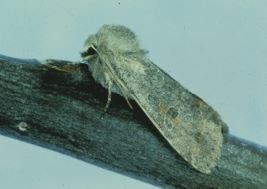
The adult GFW complex are members of the Noctuid family and as their name implies, fly at night. Flight begins during apple bud development and peaks at tight cluster with flight completed by the pink stage (Graph 1). GFW adults have a wingspread of about 1.5 inches. The forewings are grayish pink; each is marked near the middle with 2 purplish gray spots, outlined by a thin pale border with the hind wings lighter in color than the forewings (Image 1). Females begin oviposition on twigs and developing leaves when apples are in the half-inch green stage. GFW eggs are about 3/8" in diameter and 3/16" in height. GFW eggs are white with a grayish tinge and ridges radiating from the center (Image 1). The egg takes on a mottled appearance shortly before hatch. A female will deposit only 1 or 2 at any given site, laying several hundred eggs from late March to mid-May in the Hudson Valley.
In the northern regions of the Champlain Valley and throughout the mid-Hudson Valley, the GFW can be a severe pest on early developing apple. The GFW larva pass through 6 instars, the early stages possessing a grayish green body, brown head and thoracic shield. Mature larvae, about 1.5" in length, have a light green body and head. A number of narrow white stripes run along the top of the body with a wide, more pronounced white line running along each side. The areas between the stripes are speckled white. Early stages of larvae feed on foliage and flower buds, found inside rolled leaves or clusters (Image 2). Mature larvae will damage flower clusters during bloom, feeding on developing fruit and foliage 2 weeks after petal fall with peak populations during bloom (Graph 2). The fruit remaining on the tree will have both shallow and deeply indented corky scars at harvest, indistinguishable from obliquebanded leafroller injury (Image 3). Larva then drop to the ground, burrow into the soil to pupate and overwinter 2-4 inches into the soil to emerge the following spring as adults.
Control: In years of heavy infestation pressure from GFW, as much as 10% fruit injury can occur. Employing adult pheromone trap captures will provide growers with information on GFW presence and the onset of adult flight. Scouting for larva to determine levels of pest pressure should begin shortly after tight cluster. Although NY has not developed thresholds for this pest, a provisional threshold of 1 larva or feeding scar per tree has been used to begin applications in Massachusetts. A more conservative threshold should be applied in high valued apple varieties on dwarfing rootstock of high-density planting systems. If GFW populations historically cause economic injury to fruit, management should begin from tight cluster to pink to target the pre-bloom Lepidoptera complex. The GFW complex and OBLR are less susceptible or resistant to most organophosphates, with the exception of chlorpyrifos (Lorsban, IRAC Class 1B). If Lorsban were used as a pre-bloom foliar application, it would also control San Jose scale. Asana, Ambush / Pounce, Baythroid, Danitol, Warrior, pyrethroids in IRAC Class 3, tend to have highest efficacy against larva under cooler temperatures (<72oF). Generally, as temperature increases larva metabolize / detoxify pyrethroid chemistries more effectively, while OP's, Carbamates and newer chemistries tend to be more stable and less susceptible to this phenomenon.
The Bt products such as Biobit, Dipel, Javelin, and MVP (IRAC 11 B2) also have a low impact on beneficial mite and are very effective against OBLR and the GFW complex. The Bt products can be used through bloom as needed and their use should be optimized employing multiple applications at 5-7 day intervals at the low-labeled rate. Intrepid (methoxyfen-ozide) (IRAC 18A) another reduced risk insecticide very effective against the larva, imitates the natural insect molting hormone and works by initiating the molting process. Intrepid is quite safe to birds, fish, and most beneficial insects. Proclaim (emamectin benzoate) (IRAC 6), a second-generation avermectin insecticide related to Agri-Mek, is also an excellent insecticide against the GFW complex while having a low impact on beneficial mites. If European red mite (ERM) has emerged, Proclaim, used with a penetrating adjuvant, would reduce early ERM populations. Altacor (chlorantraniliprole), Belt (flubendiamide) (IRAC Class 28), Delegate (spinetoram) and Entrust (spinosad) (IRAC Class 5), have been used successfully against the surface feeding and internal Lep. complex. However, the placement for these materials has been predominately at the onset of hatch of the summer generation larva of OBLR, providing excellent results in NY State.
As we would be managing the overwintering OBLR larva at the same time as we would the control of GFW, we need to consider these applications in light of OBLR management through out the remainder of the season. Since the development of insecticide resistance is dependent on the volume and frequency of applications of insecticides and the inherent characteristics of the insect species, we should limit one insecticide class to a single generation of pest for resistance management purposes. The present model for insecticide resistance management (IRM) practices then is to use a single insecticide class for a single generation of insect pest. For example, an IRM program against the lepidopteran complex, specifically OBLR, would use effective insecticides listed above (X, Y, Z) in three different IRAC classes (A, B, C) throughout the season.
Insecticide X (Class A) 1 application @ TC-P for GFW, or PF for OBLR, RBLR, LAW, OFM larva
Insecticide Y (Class B) 2 applications @ 14d; first emergence of 1st brood OBLR larva
Insecticide Z (Class C) 1 application @ first emergence of 2nd brood OBLR larva if needed.
Given the historic failures the apple industry has experienced managing the leafroller and internal worm complex, we should consider designing programs to maintain the effectiveness of these excellent IPM tools beginning early in the season, before the heat of the battle begins.
Adapted from Chapman P. J. And Lienk S. E. Green Fruitworms. New York's Food And Life Sciences Bulletin No. 50, Entomology (Geneva) #6. October 1974 http://fls.cals.cornell.edu/OCRPDF/50a.pdf
First Flight: Considerations for Early "Worm" Management to NY Apple (pdf; 1469KB)


Apples

Apricots

Asparagus

Beets

Blueberries

Broccoli

Brussels Sprouts

Cabbage

Carrots

Cauliflower

Cherries

Cucumbers

Dry Beans

Eggplant

Ethnic Vegetables

Garlic

Grapes

Horseradish

Kohlrabi

Leeks

Lettuce / Leafy Greens

Melons

Nectarines

Onions

Parsnips

Peaches

Pears

Peas

Peppers

Plums

Potatoes

Pumpkins / Gourds

Radishes

Raspberries / Blackberries

Rhubarb

Rutabaga

Snap Beans

Squash - Summer

Squash- Winter

Strawberries

Sweet Corn

Sweet Potatoes

Tomatoes

Turnips