2015 CCE ENYCHP Pumpkin Variety Trial
Chuck Bornt, Team Leader, Extension Vegetable Specialist
Eastern New York Commercial Horticulture
March 17, 2016
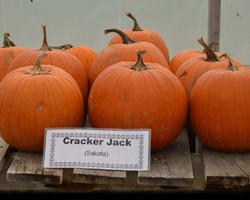
I know it's late and most of you probably have all or most of your seed already ordered, but I thought I would share our Pumpkin Variety Trial information with you just in case you are intrigued by some of these varieties and would like to try them this year. I would also like to take this opportunity to thank our host grower, Rich Wertman of Wertman Farm and Greenhouses located in Melrose, NY which is in Rensselaer County about 10 miles north of Troy (just to give you some reference points). Rich and his family grow about 60 acres of pumpkins, ranging from pies types to Jack-O-Lanterns. I would also like to thank the seed companies that provided seed and feedback for this trial (Table 1).
Trial Particulars: The trial was direct seeded June 11, 2015. Two seeds were planted in six hills in side by side rows (12 hills per plot per replication) spaced on 6 foot centers: in-row spacing was determined based on seed company recommendations square footage per plant and converted to be as close as possible based on our 6 foot row center spacing and can be found also in Table 1. Each variety was replicated twice for a total of 24 hills per variety. Rows were marked and 400 lbs of 19-19-19 fertilizer was placed in the rows with a Monosem 2 row planter and seeds were then jabbed in by hand using a jab planter. After planting, Sandea (halosulfuron) at 0.5 ounces per acre plus Dual Magnum (metolachlor) at 1.0 pints per acre plus Command ME (clomazone) at 1.0 pint per acre was applied for weed control. In mid-July, an additional sidesdress of 150 pounds Urea per acre was applied. Starting the last week in July, the first fungicide application for Powdery Mildew as applied. A total of 5 fungicide applications were made weekly using these products in this sequence plus chlorothalonil: Quintec, Torino, Procure, Vivando and a second application of Quintec.
Results: Plots were harvested October 6, 2015. The per acre total number of marketable fruit, marketable fruit weight and average fruit size can be found in Table 2. Also in Table 2 you can find the calculated number of bins (24" tall) based on an average bin weighing 600 pounds and the average number of pumpkins per bin based on the average fruit size. During data collection, we weigh each individual marketable fruit and record it. We do this so we can get an idea of how uniform the fruit size is for each variety and Table 3 is the percentage of fruit based on 5 pound increments. For example, if you look at Racer Plus you will find that 44% of the total marketable fruit are between 5 and 10 pounds, 50% are between 10 and 15 pounds while 6% are 15 to 20 pounds. And finally Table 4 gives you a brief description of each variety.
Summary: The information presented in this report I feel is a very strong representation of how these varieties will perform on most farms with similar care and conditions. However, each farm is different so I suggest that if you decide to try any of these varieties, trial them on a limited scale the first year to see how they actually perform on your farm and your cultural practices. With that said, there are several varieties that stood out in the trial and I would highly recommend. Under pie pumpkins, Early Abundance and Jack Sprat were very attractive and excellent yielding. If you are looking for a novelty type in the pie size, Toad was very unique with its nice orange color, tear drop shape and numerous "warts". This variety I think would be a great choice for retail sales but because of the warts, may be more sensitive to bruising in boxes during delivery. If you have been looking for a larger "munchkin" type then Orangita would be a great choice with it's deep ribbed or scalloped, bright orange fruit. And another novelty type to look at would be WeeeeeOne which looks like a large Jack-O-Lantern that has been shrunk to 1/2 pound.
For small to medium sized Jack-O-Lanterns, those of you that have tried Racer and liked it, might want to look at Racer Plus which is an improved Racer with Powdery Mildew disease tolerance added - uniform, blocky upright round fruit shape with dark orange color and moderate ribbing. If you are looking for another novelty variety, Warty Goblin would be one to certainly look at for retail sales. The orange and green coloring with numerous, large warts really makes it stand out in a crowd of pumpkins.
And finally for large to extra large Jack-O-Lanterns, the one variety that stole the show was a new release from Harris Seeds called Kratos. This variety was uniform, averaging between 20 and 25 pounds with a great dark orange color, medium ribbing and a strong upright round blocky shape with a strong, well anchored handle that seemed to hold its dark green/black color. Rhea, the smaller sister to Cronus also did well in the 20-25 pound category. Another new release from Harris called Zeus should also make the short list especially if your market is looking for that 15-18 pound consistent fruit size. Zeus also has in addition to its Powdery Mildew tolerance, virus tolerance (Zucchini Yellow Mosaic Virus). And by far the largest Jack-O-Lanterns were produced by Cronus, which produces some huge, very attractive fruit (30 pounds plus). However, this variety also requires lots of space as it is a full vining variety. Harris recommends 10 foot centers with 3 - 5 feet in row.
Pumpkin Variety Trial Photos (pdf; 6280KB)


Apples

Apricots

Asparagus

Beets

Blueberries

Broccoli

Brussels Sprouts

Cabbage

Carrots

Cauliflower

Cherries

Cucumbers

Dry Beans

Eggplant

Ethnic Vegetables

Garlic

Grapes

Horseradish

Kohlrabi

Leeks

Lettuce / Leafy Greens

Melons

Nectarines

Onions

Parsnips

Peaches

Pears

Peas

Peppers

Plums

Potatoes

Pumpkins / Gourds

Radishes

Raspberries / Blackberries

Rhubarb

Rutabaga

Snap Beans

Squash - Summer

Squash- Winter

Strawberries

Sweet Corn

Sweet Potatoes

Tomatoes

Turnips