

Spotted Winged Drosophila found locally and throughout New York and New England
Laura McDermott, Team Leader, Small Fruit and Vegetable Specialist
Eastern New York Commercial Horticulture
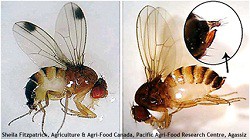
Last week and early this week scouts throughout the state have reported finding SWD in vinegar traps or through other monitoring methods. These findings have been very small as far as numbers of individuals, but extension specialists in New England are warning that fruit fly numbers balloon quickly from initial sighting to infestation levels. Counties that have reported SWD catches include Albany, Columbia, Monroe, Orange, Orleans, Tompkins and Ulster counties. Similar findings have been reported in Connecticut, Maine, New Hampshire, Massachusetts and Pennsylvania throughout the early summer. In light of these findings, blueberry, summer and fall raspberry and day-nuetral strawberry growers are urged to be vigilant about this pest.
Monitor for SWD- There are two basic strategies to monitor for SWD- trapping adult flies and monitoring fruit for larval infestation. To trap adult flies, you can use a clear plastic cup with a removable lid and poke several small holes (literature reports that you should use a drill bit of 0.1875 inch) 3" up from bottom all around the cup. Pour 2" of apple cider vinegar (studies have also tested sake, but the vinegar seems to work the best) into the cup. A drop of liquid soap helps break the surface tension so that the flies will sink. Use a sturdy wire or plastic zip tie to hang the trap at the fruiting level of the canopy on the shaded side. Ideally this should be done prior to fruit coloring. A minimum of three traps should be placed in a crop and the traps should be cleaned and checked weekly. Some traps use yellow sticky cards that are suspended above the vinegar. This may be helpful as you learn to ID the insect. To ID the submerged flies, you will need to strain vinegar through a fine filter. SWD males are MUCH easier than females to ID as they have the spotted wings. Female flies do not have spots on the wings and are IDed by looking at the ovipositor which is quite prominent in SWD. There are many fruit flies that may be drawn to the vinegar trap, so if you have insects in the vinegar, don't panic. For more information about
making your own traps, check out: http://www.youtube.com/watch?v=_DX9K8e6ra8
Managing SWD in Berry Crops
When to pull the trigger will be the trickiest decision for most growers. Anecdotally, extension researchers with just one season of experience are suggesting that growers not wait until they see large numbers of SWD in vinegar traps. This is because apple cider vinegar traps do not seem to be good early indicators of SWD. In fact, most folks have been able to find larvae in fruit at close to the same time they are catching adults in the traps. Yeast traps, which are much tricker to see the flies in, have been shown to be much better lures, and some folks have suggested adding cheap wine to the apple cider to increase the potency of the phenol given off.
Once you do decide to spray, the interval will depend on the materials you choose. In fall raspberries, a Malathion (used for control of Japanese Beetle 1 DTH, 12 hr REI) and Delegate (1 DTH and 4 hr REI) rotation on a 7-10 day cycle should provide adequate control if you start early enough. Spiking the mixture with a sugar solution of 1 lb of sugar per 100 gallons may help lure fruit flies into sprayed crop. Other labeled materials include Molt-X and Entrust. For organic growers, Entrust should be used in rotation with Pyganic, but Entrust will provide the most efficacy. The spray program for organic growers needs to be closer to 5days to insure control.
For day neutral strawberry growers, materials used for tarnished plant bugs should help knock back SWD, and the use of sugar in the tank might improve the efficacy of the product for SWD. AzaSol is labeled for SWD. Aza-Direct, another formulation of azadiractin, is OMRI approved as is Pyganic. The azadirachtin materials have 4 hours REI. Pyganic has 12 hours.
The cultural aspects of controlling these pests include picking the crop VERY clean. Remove all fruit that is spent. Try to gather drops (or spray the ground). Cull piles of fruit should be buried daily.
How long does it take for fruit fly to develop? Egg to larvae is usually 1-2 days but it can take as few 2 hours. Chilling fruit to almost 32 degrees may actually kill larvae, but temperatures around 40 degrees will only slow development.


Apples

Apricots

Asparagus

Beets

Blueberries

Broccoli

Brussels Sprouts

Cabbage

Carrots

Cauliflower

Cherries

Cucumbers

Dry Beans

Eggplant

Ethnic Vegetables

Garlic

Grapes

Horseradish

Kohlrabi

Leeks

Lettuce / Leafy Greens

Melons

Nectarines

Onions

Parsnips

Peaches

Pears

Peas

Peppers

Plums

Potatoes

Pumpkins / Gourds

Radishes

Raspberries / Blackberries

Rhubarb

Rutabaga

Snap Beans

Squash - Summer

Squash- Winter

Strawberries

Sweet Corn

Sweet Potatoes

Tomatoes

Turnips

Upcoming Events
Introduction to Small Fruit Workshop

September 21, 2026
Millbrook, NY
Join Cornell Cooperative Extension of Dutchess County for a presentation on small fruit establishment, production, and management with ENYCHP's Berry Specialist Heather Kase!