

Onion Thrips Management Recommendations for 2018
Ethan Grundberg, Vegetable Specialist
Eastern New York Commercial Horticulture
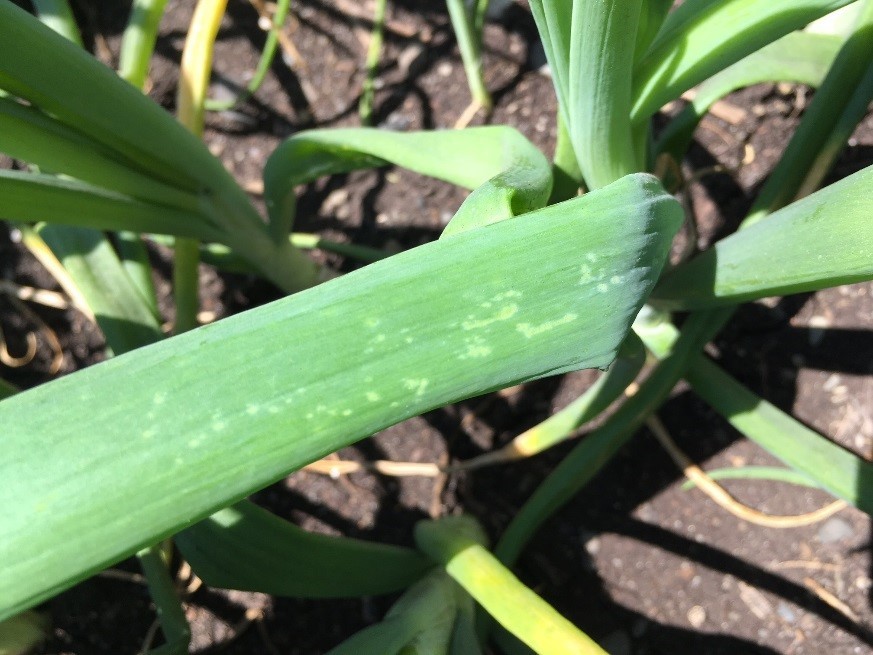
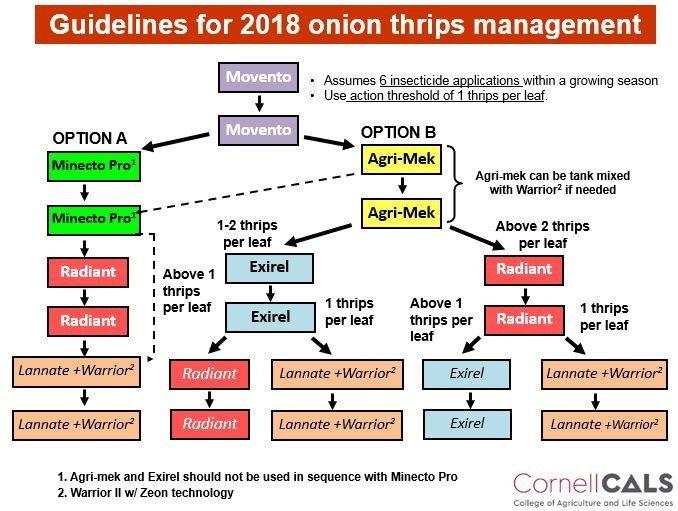
Most larger scale onion growers in the region are already familiar with Dr. Brian Nault's insecticide sequence recommendations for onion thrips management. However, more products have been registered in New York in the last few years that provide alternative options for conventional thrips management (specifically Exirel and Minecto Pro). It's worth keeping in mind that Dr. Nault's recommendations are based on two primary principles:
- Scouting and only spraying at threshold: The days of calendar sprays are long gone. Given the cost of some of the newer chemistries used for thrips management, growers must scout fields and confirm that thrips populations have reached a level of at least an average of 1 thrips per leaf before spraying. Spraying before thresholds are reached not only weakens the resistance management strategy (see point 2), but also cuts into grower profits by unnecessarily increasing the number of insecticide applications each year.
- Resistance management: Onion thrips produce multiple generations each year. They also develop resistance to insecticides more readily than other pests that reproduce more slowly. One of the goals of the recommended insecticide sequence is to avoid exposing multiple generations per year to the same insecticide. By avoiding the exposure of multiple thrips generations to the same active ingredients in the same year, growers can help preserve the useful life of insecticides that are effective at managing thrips.
The chart that follows outlines several different insecticide sequences developed by Dr. Nault for growers to follow depending upon the severity of thrips pressure in the field. It should be noted that, as indicated below, Minecto Pro is a pre-mix of the same active ingredients found in Agri-Mek and Exirel, so it should NOT be used in sequence with those products. Addtionally, almost all of the insecticides listed in the chart should be used with a non-ionic penetrating surfactant, such as Dyne-Amic or LI700. Only Warrior and Lannate are compatible with spreader-sticker type adjuvants. Since Bravo Weatherstik is formulated with a sticker, it should NOT be mixed with Movento, Minecto Pro, Radiant, Exirel, or Agri-Mek.
This article was published in the June 7th 2018, ENYCHP Vegetable News. Click here to view the full newsletter.


Apples

Apricots

Asparagus

Beets

Blueberries

Broccoli

Brussels Sprouts

Cabbage

Carrots

Cauliflower

Cherries

Cucumbers

Dry Beans

Eggplant

Ethnic Vegetables

Garlic

Grapes

Horseradish

Kohlrabi

Leeks

Lettuce / Leafy Greens

Melons

Nectarines

Onions

Parsnips

Peaches

Pears

Peas

Peppers

Plums

Potatoes

Pumpkins / Gourds

Radishes

Raspberries / Blackberries

Rhubarb

Rutabaga

Snap Beans

Squash - Summer

Squash- Winter

Strawberries

Sweet Corn

Sweet Potatoes

Tomatoes

Turnips

Upcoming Events
Field Day at Philia Farm

August 6, 2026
Johnstown, NY
Visit organic seed production trials and tour the farm to see small-scale production systems at work, including tarping, cover cropping, and the use of assorted mulches and covers to modify the growing environment.
Capital Region Orchard Twilight Meeting
August 11, 2026
Rexford, NY
Join the ENYCHP and Cornell scientists on August 11 for the Capital Region Orchard Twilight meeting in Saratoga! We will be touring Bowman Orchards and reviewing seasonal recommendations for pests and diseases for apples, plums, and berries, as well discussing crop insurance.
NYSDEC Pesticide Applicator Recertification Credits: 1.25 in categories 22, 1A, & 10. Refreshments will be provided.
Free to attend, however we do ask that you register ahead so we know how many people to expect.
Champlain Valley Orchard Storage Meeting
August 26, 2026
Chazy, NY
Join various experts from Cornell and Cooperative Extension at an orchard storage meeting for the Champlain Valley in Chazy from 1 to 4PM on August 26th. Free to attend, however we do ask that you register ahead so we know how many people to expect.