Eastern New York Commercial Horticulture Enrollment

Program Areas

  • Food Safety
  • Variety Evaluation
  • Market Development
  • Pest Management
  • Cultural Practices

Enrollment Benefits

  • Telephone / Email Consultations
  • Newsletter
  • Direct Mailings
  • Educational Meetings & Conferences
  • In-Field Educational Opportunities
  • On-Farm Research Trials

ENYCH Enrollment Form (PDF; 372KB)

Enrollee Login

Password:

Log In To Access:

  • Helpful Diagnostic Tool:
      What's wrong with my crop?

Not an Enrollee? Enroll Now!

Online Enrollment Form

Allium Leafminer Active in Southern Pennsylvania

Teresa Rusinek, Vegetable Specialist
Eastern New York Commercial Horticulture

April 18, 2018

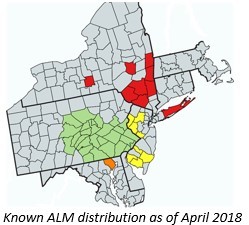
A new invasive insect pest in the Northeast known as the Allium leafminer (ALM), Phytomyza gymnostoma, damages crops in the Allium genus (e.g., onion, garlic, leek, scallions, shallots, and chives) and is considered a major economic threat to Allium growers. Originally from Europe, ALM was first detected in Lancaster County, Pennsylvania in December of 2015 and in New Jersey and New York in 2016. As of fall 2017, ALM activity has been confirmed throughout eastern Pennsylvania, New Jersey, Delaware, southeastern New York as well as Tompkins and Suffolk counties.
ALM is currently active in Lancaster, PA where the first signs of adult fly emergence were detected on April 13, 2018. Based on our observations from last spring in the Hudson Valley, we expect emergence in our area in the next week or so.  ALM will continue to emerge, feed and lay eggs in alliums over about 4 weeks.  Leaf mining from larvae will begin to show up within two weeks after first adult emergence and intensify over the duration of the flight.  The larvae mine their way toward the base of the allium plant where they will pupate. 
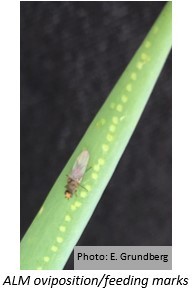
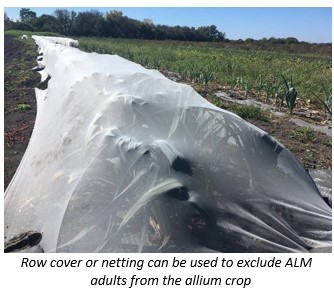
Growers who have alliums with green tissue growing in the field or in high tunnels now in southeastern New York should consider protective measures soon, especially in Orange, Ulster, Dutchess, Columbia, Sullivan, and Schoharie counties where significant infestations were observed last year.  If you have small plantings that can be covered with row cover to exclude emerging ALM flies, now is the time to do so as long as you didn't have infested alliums (including wild onion grass) in the same space last season.   Growers with larger plantings may consider applications of insecticides if and when significant ALM activity is observed in the allium crop. There are both organic and conventional insecticides labeled for allium crops to control this type of leafminer.  Insecticide efficacy tests are currently being conducted in both New York and Pennsylvania. It is important to carefully observe your allium crops over the next few weeks.  ALM oviposition/feeding may initially be observed along field edges. Be vigilant and please call  or email either Teresa Rusinek  at 845 389-3562, tr28@cornell.edu  or Ethan Grundberg at  617 455-1893, eg572@cornell.edu  if you see evidence of ALM feeding or have any questions about management. 


more crops
Apples

Apples

Apricots

Apricots

Asparagus

Asparagus

Beets

Beets

Blueberries

Blueberries

Broccoli

Broccoli

Brussels Sprouts

Brussels Sprouts

Cabbage

Cabbage

Carrots

Carrots

Cauliflower

Cauliflower

Cherries

Cherries

Cucumbers

Cucumbers

Dry Beans

Dry Beans

Eggplant

Eggplant

Ethnic Vegetables

Ethnic Vegetables

Garlic

Garlic

Grapes

Grapes

Horseradish

Horseradish

Kohlrabi

Kohlrabi

Leeks

Leeks

Lettuce / Leafy Greens

Lettuce / Leafy Greens

Melons

Melons

Nectarines

Nectarines

Onions

Onions

Parsnips

Parsnips

Peaches

Peaches

Pears

Pears

Peas

Peas

Peppers

Peppers

Plums

Plums

Potatoes

Potatoes

Pumpkins / Gourds

Pumpkins / Gourds

Radishes

Radishes

Raspberries / Blackberries

Raspberries / Blackberries

Rhubarb

Rhubarb

Rutabaga

Rutabaga

Snap Beans

Snap Beans

Squash - Summer

Squash - Summer

Squash- Winter

Squash- Winter

Strawberries

Strawberries

Sweet Corn

Sweet Corn

Sweet Potatoes

Sweet Potatoes

Tomatoes

Tomatoes

Turnips

Turnips

more crops

Upcoming Events

2026 Winter Cut Flower Webinar Series

Event Offers DEC Credits

January 6, 2026

The fifth annual CCE Cut Flower Webinar Series begins on January 6, 2026 and continues over 5 weeks on Tuesdays. This is a very popular series of online events you won't want to miss, with topflight speakers, a wide variety of subjects concerning growing cut flowers and plenty of interaction between speakers and attendees.  

Tuesdays 1pm-3pm January 6, 2026 - February 3, 2026 (The webinar held on February 3 will run 1pm-4pm)

Cost: $60.00 for all five sessions, $20 for single sessions

Webinars will be recorded, and all the recordings will be sent to registrants for future review.

View 2026 Winter Cut Flower Webinar Series Details

Expanding Farm Sales: Markets, Profits, and Branding Series

January 10, 2026

Looking to diversify where you sell your farm products? This four-part workshop series helps farmers explore new opportunities in direct-to-consumer, wholesale, and institutional markets. Learn how to meet buyer expectations, price for profitability, and build lasting relationships that support your business goals. Participants will strengthen marketing and communication skills, evaluate which sales channels best fit their farm, and connect with buyers, distributors, and local partners who can help expand their reach. Whether you're just starting out or ready to grow your market presence, this program will help you chart the right path for your farm's future.

Four Session Series: Saturdays from 10AM to Noon, January 10-January 31, 2026

Attend at one of three locations: Schoharie Extension Center - Cobleskill, NY; Otsego Education Center - Cooperstown, NY; Via Zoom

Pre-registration is requested! Fee: $25 Register Here

Any questions can be directed to Kelley Doolin at kmd322@cornell.edu

View Expanding Farm Sales: Markets, Profits, and Branding Series Details

Pesticide Applicator Certification Exam Prep Course

January 13 - January 14, 2026

Join ENYCHP specialists for an in-depth review of topics covered on the NYS DEC pesticide applicator certification exam. This two-day virtual course includes explanation of key concepts on the core exam, test-taking tips for the core and category exam, practice questions, and Q&A with instructors. Course materials, including program recordings, practice exams, and DEC materials will be available to registrants after the program. This training is geared toward certification categories 1A (agricultural plant), 21 (field and forage), 22 (fruit), and 23 (vegetable). 

View Pesticide Applicator Certification Exam Prep Course Details

Announcements

Resources from CCE ENYCHP!


This website (https://enych.cce.cornell.edu/) contains our calendar of upcoming programs and registration links. For updated programmatic information, technical resources and links to newsletters please see our program blog site: https://blogs.cornell.edu/enychp/.
We also maintain the following online resources that you can view directly from these links:

• CCE ENYCH YouTube (program videos): https://www.youtube.com/channel/UCSk_E-ZKqSClcas49Cnvxkw

• CCE ENYCH Facebook (program social media): https://www.facebook.com/CCEENYCHP/

• CCE ENYCH Instagram (program social media): https://www.instagram.com/cceenychp/?hl=en


NEWSLETTERS  |   CURRENT PROJECTS  |   IMPACT IN NY  |   SPONSORSHIP  |   RESOURCES  |   SITE MAP